
A more intentional way to invest in Nigerian businesses, guided by your values.
For years, our customers have asked us some version of the same question: "Is there a way to grow my money that sits right with what I believe?"
Some don't want to profit from interest-based lending. Some would rather not own a brewery. Many simply don't like the idea of their savings sitting in companies that live on borrowed money. And almost all of them have quietly assumed the same thing: that investing by your values means accepting lower returns.
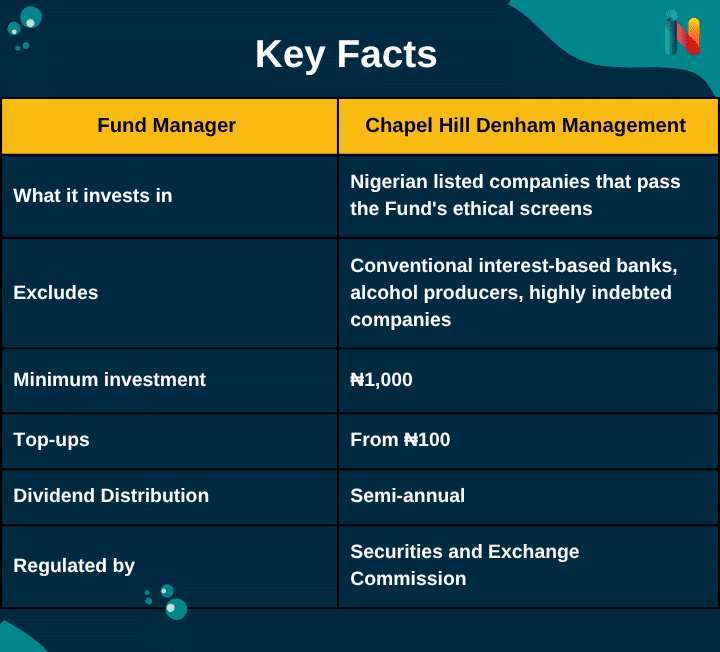
We have recently launched a fund that answers that question, and challenges that assumption. The Nigeria Ethical Growth Fund (NEGF), managed by Chapel Hill Denham Management, is now live on InvestNaija.
What makes it "ethical"
The Fund invests in Nigerian companies and leaves out three groups:
- Conventional interest-based banks
- Alcohol producers
- Companies that depend on heavy borrowing
These rules reflect the values of the Fund's investors, whatever their faith. They aren't a judgement on the companies left out, many of which are well run. They simply sit outside this mandate.
The screens aren't new, either. The same exclusions sit at the heart of the faith-based indices run by global providers such as MSCI, S&P Dow Jones and FTSE Russell, and similar screens are used by faith-based funds around the world.
"But won't I earn less?"
This is the question we set out to answer, and the numbers surprised even us.
Our research team measured how much profit each business earns on the money it uses, a measure called return on capital employed (ROCE). Over the past eleven years, the typical Nigerian bank earned about ₦3 a year for every ₦100 it used. The brewers earned about ₦12. The typical company the Fund can own earned about ₦20.
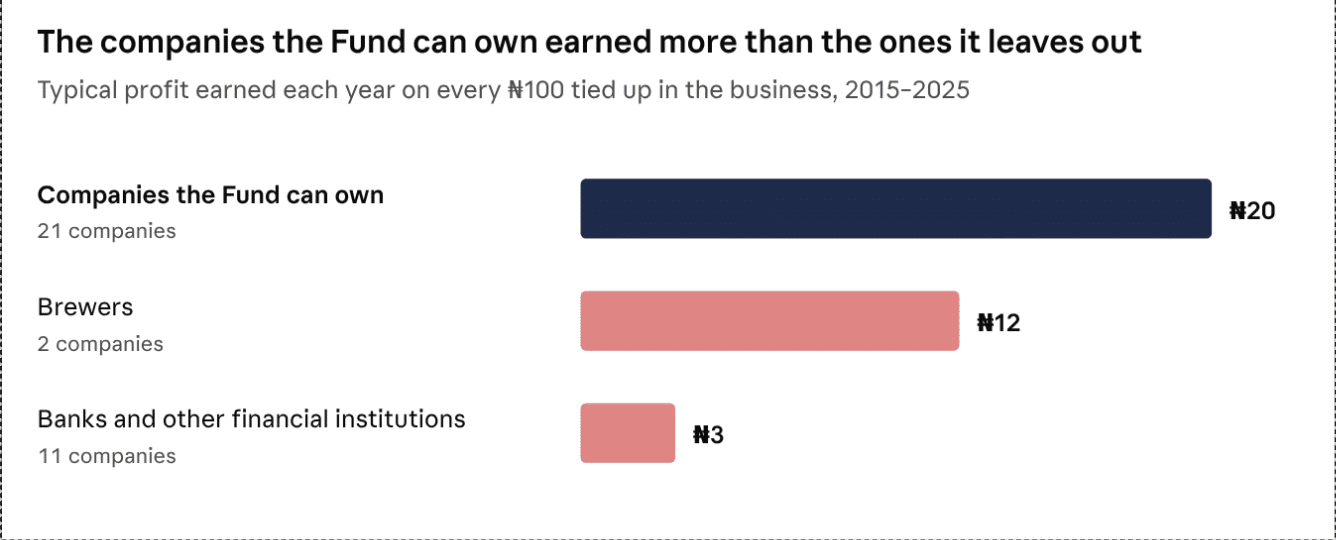
Median return on capital employed, 2015–2025. Source: company reports, Chapel Hill Denham research.
In other words, the Fund has fewer companies to choose from, but not weaker ones. Some of the world's best-known investors, including Terry Smith of Fundsmith and Sir Chris Hohn of TCI, avoid bank shares too. Their reasons are financial rather than ethical: banks run largely on borrowed money, and even a well-run bank can be hurt by its rivals' mistakes. Our values lead us to the same place by a different road.
How the Fund picks its companies
Picture two shops, each with ₦100 tied up in stock and equipment. The first makes ₦25 profit a year. The second makes ₦5. Both are profitable, but the first can pay for a new branch every four years from its own profits. The second would need twenty.
That's the idea behind the Fund. We look first for businesses that earn high returns on the money they use, because those are the businesses that can grow without constantly borrowing or asking their owners for more.
After the ethical screens, our research team covers 21 listed Nigerian companies. Half of them earn more than ₦20 a year on every ₦100 they use, and the top quarter earn about ₦37. Those high returns are spread across food, telecoms, cement, power, fuel and agriculture, so the Fund can be choosy without betting everything on one industry.
Three principles guide every decision:
- Returns that last. One good year proves little. We look for returns that hold up in hard times. In Nigeria's two sharpest downturns of the decade, the 2016 recession and the 2020 pandemic, the top quarter of our universe still earned an impressive ₦23 to ₦26 on every ₦100.
- Businesses with a "moat". Something that keeps competitors at bay: a brand families trust, the lowest costs in the industry, a hard-won licence, or customers who find it costly to switch.
- A sensible price. A great business can still be a poor investment if you pay too much for it. Equally, we'll own companies with lower returns today when we believe they're improving or the price makes up for it.
Who's the Fund for?
The Nigeria Ethical Growth Fund is built for investors who:
- want their money to reflect their values, whatever their faith;
- want to own a share of Nigeria's strongest businesses, without picking individual stocks;
- are investing for the long term, ideally 5 years or more, and can ride out the ups and downs that come with owning shares.
If you'll need your money back in a few months, a money market fund is likely a better fit.
How to invest
You can invest in the Nigeria Ethical Growth Fund in minutes on InvestNaija:
- Open the InvestNaija app (App Store or Google Play) or go to app.investnaija.com, and log in or sign up.
- Go to Mutual Funds and select the Nigeria Ethical Growth Fund.
- Read about the fund and click Invest
- Enter how much you'd like to invest, from ₦,1000, and pay with your preferred option.
- Track your investment and top up whenever you like, right in the app.
Your values, without settling
Investing in line with what you believe shouldn't mean settling for second best. With the Chapel Hill Denham Nigeria Ethical Growth Fund, it doesn't have to. You get a portfolio of quality Nigerian businesses, chosen by one of the country's most experienced investment teams, and screened to match your values.
Start investing in the Nigeria Ethical Growth Fund today on the InvestNaija app or at app.investnaija.com.
Haven't joined our Whatsapp Channel yet? Join us here for IPO updates!
Ready to start your journey? Download the InvestNaija app today from the Apple App Store or Google Play Store. With tools like Learn, Save, and Invest, you’ll have everything you need to invest confidently and wisely.